
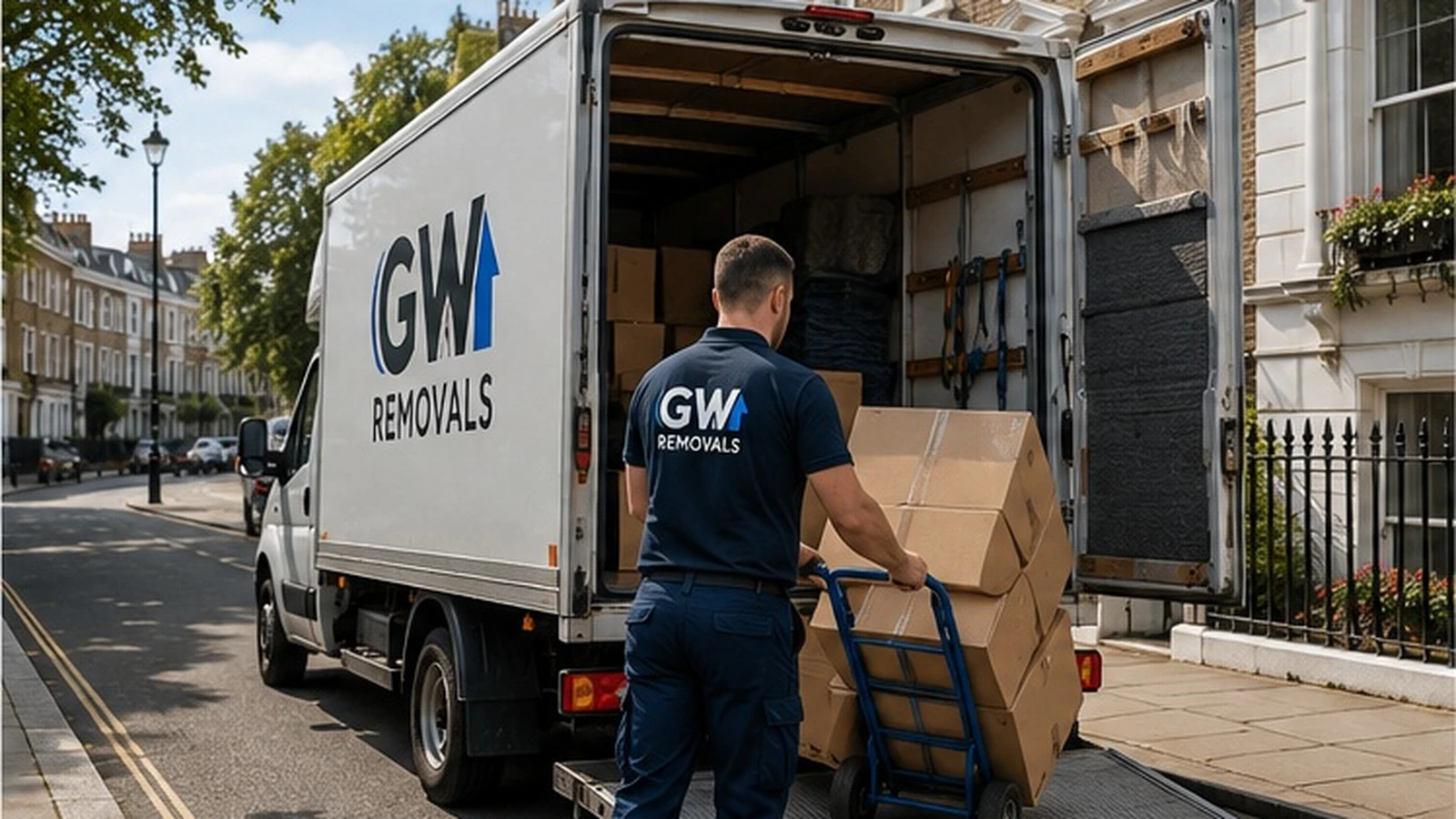
If you’re planning a house move, one of the first practical questions is what size van you actually need — and “a Luton van” isn’t as fixed a size as it sounds. This guide breaks down real, manufacturer-verified Luton van dimensions and payloads, why they vary between models and body-builders, and how to work out what your move actually needs.
What Is a Luton Van and Why Removal Companies Use It
A Luton van is a box-bodied vehicle with the load area extending forward over the cab, giving a taller, more square-sided load space than a standard panel van. That shape makes it easier to stack boxes and furniture efficiently, and most are built with a walk-in load area and a tail lift, which is why they’re the standard vehicle for house and flat removals in the UK.
External vs Internal Dimensions — What Actually Matters
Vans are often advertised by their overall external length, but that figure won’t tell you what actually fits inside. External dimensions matter for practical things like whether the van clears a height barrier, fits on your street or in a car park — internal (loadspace) dimensions are what determine how much you can actually load. When comparing van sizes, always ask for the internal loadspace length, width and height, not just the vehicle’s overall footprint.
Load Volume and Payload Explained
Two figures matter when sizing a van, and they aren’t the same thing. Volume (measured in cubic metres) tells you how much space is available. Payload (measured in kg) tells you the maximum weight the vehicle is legally allowed to carry, after the weight of the vehicle, body and any fitted equipment like a tail lift is deducted. A van can run out of payload before it looks full — heavy items like books, tools or tinned goods add weight fast — or run out of space before it hits its weight limit, which is common with bulky but light items like mattresses and flat-pack furniture. Both limits need checking, not just one.
Why Luton Van Dimensions and Payload Vary by Body and Model
A “Luton van” isn’t one standardised product — it’s a box body and tail lift built onto a van or truck chassis by a specialist body converter, and the exact dimensions depend on both the base chassis and which converter built the body.
For example, the current Ford Pro™ Luton conversion (built by VFS) on the Ford Transit long-wheelbase (L3) chassis has a loadspace of 3,490mm long, 2,020–2,120mm wide and 2,200mm high — around 15.5–16.2 cubic metres depending on single or dual rear wheels. The longer L4 version extends the loadspace to 4,090mm, giving roughly 18.1–19.1 cubic metres.
A different body converter, Ingimex, builds a Luton body on that same Ford Transit chassis with a loadspace of 3,736mm (L3) to 4,119mm (L4) — noticeably longer than the Ford Pro/VFS figures above, despite sharing the same donor vehicle and wheelbase. Ingimex also builds Luton bodies on the Iveco Daily chassis, with its own dimensions again.
This is the key point: the base van doesn’t tell you the box size on its own. Two “Ford Transit Lutons” from different body-builders can have meaningfully different load lengths and volumes, so always check the loadspace dimensions on the specific vehicle you’re quoted rather than a generic “Luton van” figure from a comparison table.
Payload varies just as much. On the Ford Pro Luton range above — which comes with a 500kg tail lift fitted as standard — gross payload ranges from roughly 870kg to just over 1,035kg on the same body, depending on the engine, transmission and drivetrain fitted to the base vehicle. Fitting a tail lift or extra equipment reduces payload further, since payload is simply what’s left after the vehicle, body and equipment weight are deducted from the gross vehicle weight. If the exact figure matters for your move, ask for the payload plate figure on the specific van being used rather than a generic average.
3.5-Tonne vs 7.5-Tonne Luton Vans Compared
Most house removals use a 3.5-tonne Luton van — the size covered by the Ford Pro and Ingimex examples above — which can be driven on a standard UK car licence held before 1997, or with the right category added for newer licences. A 7.5-tonne Luton is built on a larger truck chassis rather than a van-derived chassis-cab, giving a longer, taller box, and is typically used for larger, multi-bedroom moves where a 3.5-tonne van would need more than one run.
It’s worth being precise about the terminology here: 7.5 tonnes refers to the vehicle’s gross vehicle weight (GVW) — the maximum legal weight of the loaded vehicle — not what it can carry. The actual payload is lower once the vehicle, body and tail lift weight are deducted, and varies by configuration, so it shouldn’t be assumed from the GVW figure alone. For most house removals, a 3.5-tonne Luton is the relevant size; a 7.5-tonne vehicle is usually only worth discussing directly with your removal company for unusually large moves.
How Furniture Shape Affects Usable Space
A van’s cubic capacity is a theoretical maximum — in practice, furniture rarely stacks with zero wasted space. Awkward or irregular shapes, such as wardrobes, sofas, mattresses, bikes and garden furniture, leave gaps that boxes could otherwise fill, while uniform, stackable items like moving boxes use space far more efficiently. Two house moves with an identical inventory list can end up needing different van sizes depending on how much of that inventory is boxable versus bulky and irregular.
What a Luton Van Typically Suits
As rough guidance only, a single 3.5-tonne Luton van is often enough for a studio flat, a one-bedroom flat, or a lightly furnished two-bedroom home. Larger or more heavily furnished two and three-bedroom properties can go either way, depending on the exact inventory, access and how much can be packed into boxes versus moved as bulky items. This is general guidance rather than a fixed rule — inventory, access and loading efficiency all affect what actually fits, so the only reliable way to know what a specific move needs is a proper inventory or survey.
Tail Lifts and Access
Most Luton vans used for removals are fitted with a tail lift, allowing heavy or bulky items to be wheeled or lifted level with the load floor rather than carried up a ramp or lifted manually. This is particularly useful for appliances, heavy furniture, and properties with several flights of stairs at collection or delivery. As noted above, a tail lift is usually standard on purpose-built removal Lutons, and its weight is already factored into the payload figures your removal company quotes.
Signs You Need More Than One Luton Van
- A full inventory and box count fills more than one written page
- Several large items can’t be dismantled — wardrobes, dining tables, sofas
- The property has three or more bedrooms, fully furnished
- There’s a significant amount kept in a loft, shed or garage as well as the main house
In these cases, a second van or a larger vehicle is usually more cost-effective than overloading a single van and running a second trip. If you’re weighing up van size against overall cost, our guide on removal costs in London covers how vehicle size, crew and access all affect your final price.
How GW Removals Sizes a Van for Your Move
Rather than estimating from bedroom count alone, GW Removals sizes each move around your actual inventory, access and moving date. Share photos, a short video walkthrough or a written list of what’s moving, and we’ll confirm the right van size and crew before your move — so you get a vehicle that fits your belongings without paying for space you don’t need. Our house removals and man and van services are both sized this way.
Get Your Free Quote and we’ll confirm the right van size for your move.
Frequently Asked Questions
What size is a Luton van?
It depends on the body-builder as much as the base vehicle. A typical 3.5-tonne Luton has a loadspace of roughly 3.5–4.1 metres long, 2–2.1 metres wide and 2.2 metres high, but the exact figure varies between manufacturers and body converters — always check the specific vehicle’s loadspace dimensions rather than a generic average.
How much can a 3.5-tonne Luton van hold?
Volume is typically in the range of 15–19 cubic metres depending on the body and wheelbase, while payload (the maximum weight it can carry) is usually in the 870–1,035kg range once the vehicle, body and tail lift weight are accounted for. Both figures vary by model and configuration, so the two limits — space and weight — should both be checked for your specific van.
Do all Luton vans have a tail lift?
Not always, but most Luton vans used for removals are fitted with one as standard, since it makes loading heavy or bulky items much easier. A tail lift adds weight to the vehicle, which is already factored into the payload figures quoted for that specific van.
Is one Luton van enough for a house move?
Often, for a studio, one-bedroom or lightly furnished two-bedroom property — but this is rough guidance, not a fixed rule. Larger or more heavily furnished homes may need a second van or a larger vehicle. The only reliable way to know is a proper inventory or survey of what’s moving.
What’s the difference between a 3.5-tonne and 7.5-tonne Luton van?
A 3.5-tonne Luton is van-derived and can be driven on a standard car licence in most cases; a 7.5-tonne Luton is built on a larger truck chassis with a bigger box, but requires the appropriate licence category. Note that “7.5 tonnes” refers to the vehicle’s gross weight limit, not its payload — the actual carrying capacity is lower and depends on the specific vehicle’s configuration.